 aliasoft.dev
Project
Seaway
Seaway is a full-stack architecture project designed to demonstrate modern software engineering practices including clean architecture, event-driven systems and production-ready APIs. The platform combines a scalable Java backend with a modern React frontend and production-oriented deployment patterns.
System architecture
Seaway is designed around a layered architecture inspired by hexagonal architecture principles. The system clearly separates the domain, application logic and infrastructure to maintain explicit boundaries and long-term maintainability.
Domain layer
Contains business entities, domain logic and domain invariants. The domain remains isolated from frameworks and infrastructure dependencies.
Application layer
Implements use cases through command and query handlers. This layer orchestrates domain logic without containing business rules.
Infrastructure layer
Adapters for persistence, messaging and external services including PostgreSQL repositories and Kafka producers/consumers.
API layer
REST controllers exposing validated endpoints with standardized error handling and secure filtering.
Frontend interface
The user interface is implemented with React and Tailwind CSS, providing a lightweight client for interacting with the API. The frontend focuses on clear component boundaries and maintainable UI architecture.
- React component architecture
- Tailwind CSS for design system consistency
- API integration with backend services
System architecture overview
Hexagonal architecture
Event-driven workflows
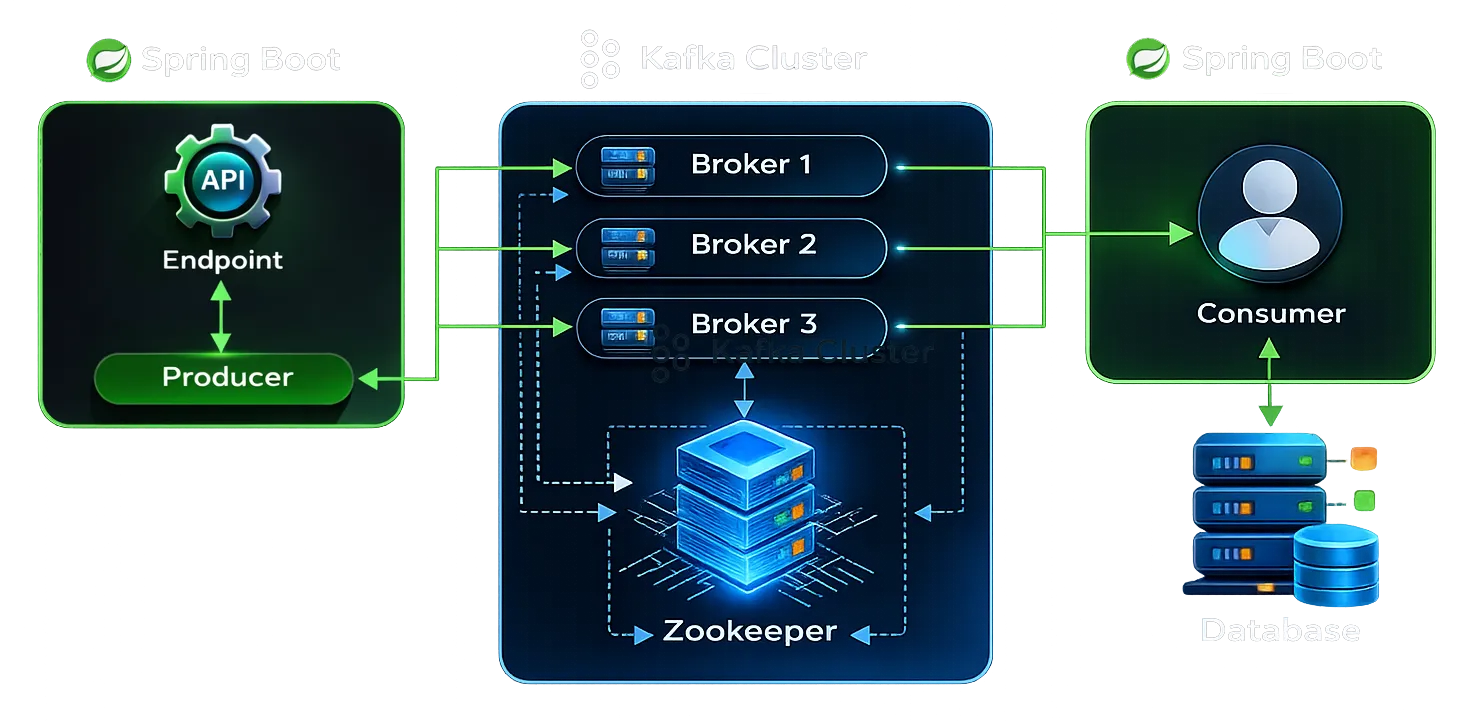
The platform uses Kafka to orchestrate asynchronous workflows between system components. Events allow services to remain loosely coupled while ensuring scalability and resilience.
Event publishing
Domain events are published when significant state changes occur, allowing other services to react asynchronously.
Retry strategies
Failed events are retried with backoff strategies before eventually being redirected to dead-letter topics for inspection.
Idempotent consumers
Consumers are designed to safely process events multiple times to ensure system consistency in distributed environments.
Event processing flow
Technical highlights
Hexagonal architecture
Clear separation between domain, application and infrastructure to maintain long-term maintainability and testability.
CQRS design
Separation of commands and queries allowing independent evolution of read models and write operations.
Event-driven workflows
Kafka-based messaging enabling loosely coupled services and resilient distributed processing.
Security practices
- DTO validation using Bean Validation
- Centralized error handling
- Secure pagination and filtering
- Secrets externalized via environment variables
- OWASP-aware API design
- Docker container hardening
- Non-root container execution
- Read-only filesystem
- Reverse proxy with Nginx
- Infrastructure-level rate limiting
Architecture
- Hexagonal architecture
- CQRS pattern
- Kafka event processing
- PostgreSQL
Stack
- Java 21
- Spring Boot
- Kafka
- PostgreSQL
- React
- Tailwind CSS
- Docker
- Nginx